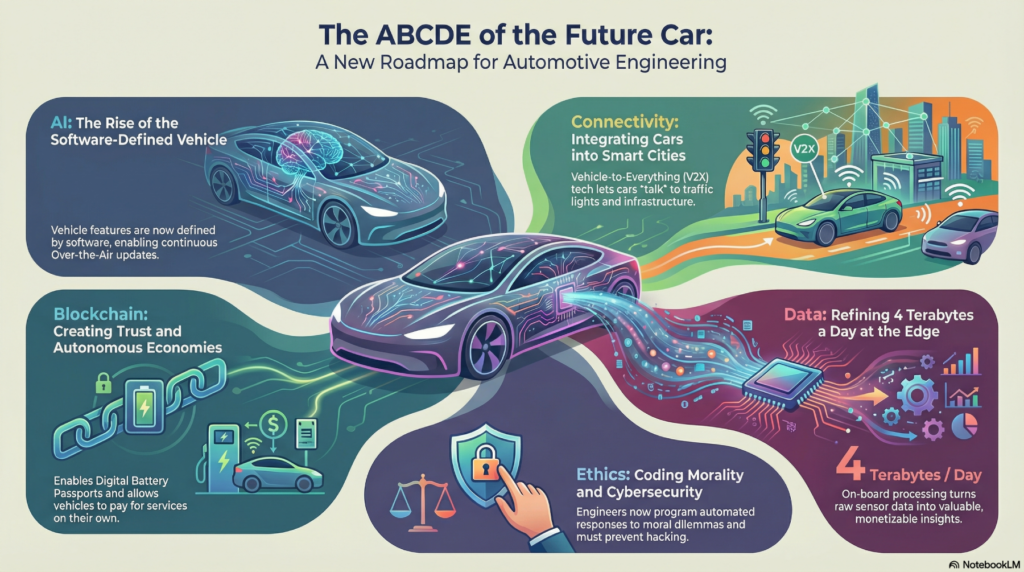
The automotive industry is no longer just about internal combustion engines and aerodynamic chassis. We are witnessing a historic pivot—a transition from traditional mechanical engineering to a hyper-connected, software-defined mobility ecosystem. As vehicles evolve into “computers on wheels,” the roadmap for engineers is being redrawn by the convergence of the ABCDE Framework: Artificial Intelligence, Blockchain, Connectivity, Data, and Ethics.
This shift isn’t just theoretical. It is the backbone of the CASE (Connected, Autonomous, Shared, and Electric) mobility revolution. For today’s automotive professional, staying relevant means moving beyond hardware durability and becoming an architect of resilient, intelligent transport systems.
1. Artificial Intelligence: From Manual Oversight to Autonomous Intelligence
In the traditional automotive world, engineering focused on hardware reliability. Today, Artificial Intelligence (AI) serves as the “brain” of the vehicle, shifting the focus to cognitive resource management.
AI’s role in automotive engineering follows a three-step progression:
- Descriptive: Analyzing what happened (telematics).
- Predictive: Using machine learning to forecast issues, such as predicting battery failure hundreds of miles before it occurs.
- Prescriptive: Prescribing unique maintenance profiles based on individual driving behavior.
By automating optimization and efficiency, AI moves the industry toward a future where vehicles aren’t just tools, but autonomous agents capable of making real-time decisions to ensure safety and longevity.
2. Blockchain: Replacing Brand Reputation with Cryptographic Truth
Trust has traditionally been built on brand reputation. However, in a fragmented global supply chain, Blockchain introduces a new standard: Cryptographic Truth.
In the future of automotive engineering, Blockchain acts as the ledger of integrity. It ensures trust in supply chains, secures Vehicle-to-Everything (V2X) communications, and enables “Vehicle Identity.” This identity allows autonomous vehicles to participate in transactions—such as paying for charging or tolls—without human intervention. By removing the “middleman,” Blockchain provides the transparency required for a truly resilient mobility network.
3. Connectivity & IoT: The Sensory Nervous System
If AI is the brain and Blockchain is the integrity, Connectivity is the nervous system. The transition from isolated telematics to a continuous Vehicle-to-Everything (V2X) mesh network is fundamental to the smart city ecosystem.
Internet of Things (IoT) sensors allow for:
- Real-time Predictive Maintenance: Constant monitoring of vehicle health.
- Over-the-Air (OTA) Updates: Ensuring software evolvability without needing a physical recall.
- Fleet Optimization: Balancing vehicle loads and routes in real-time.
Through connectivity, the vehicle becomes a crucial node in the urban infrastructure, interacting with traffic lights, other vehicles, and even the power grid.
4. Data: Moving from Silos to Edge Intelligence
Data is the fuel of the new automotive era. However, the value no longer lies in siloed, proprietary data stored in a manufacturer’s database. The shift is toward Edge Computing, where data is refined and monetized at the source—the vehicle itself.
Engineers are now tasked with managing massive data flows to optimize resource distribution. Whether it’s energy consumption in EVs or traffic flow patterns, data allows for Optimal Resource Allocation. This transition turns the vehicle from a one-time sale product into a recurring mobility service provider.
5. Ethics: Navigating Algorithmic Morality
As we delegate control to software, Ethics becomes a core engineering requirement. We are moving from “Passive Driver Safety” (seatbelts and airbags) to “Active Algorithmic Morality.”
Automotive engineers must now consider the ethical implications of data privacy and cybersecurity. How does a car choose between two unavoidable outcomes? How do we ensure that the algorithms governing our streets are unbiased and transparent? The ABCDE Framework places Ethics at the center, ensuring that technological progress does not come at the cost of human values or safety.
The Paradigm Shift: Resilient Engineering
The transition facing the industry can be summarized by a fundamental shift in priorities:
| Domain | From (Traditional) | To (Resilient Engineering) |
| Engineering | Hardware Durability | Software Evolvability |
| Trust | Brand Reputation | Cryptographic Truth |
| Connectivity | Isolated Telematics | Continuous V2X Mesh |
| Data | Siloed & Proprietary | Shared & Refined at Edge |
| Business | One-time Sales | Recurring Mobility Services |
Integrating with the Smart City Ecosystem
The future of automotive engineering is inseparable from the Smart City. Vehicles are no longer standalone units; they are vectors for delivering value within an urban ecosystem.
One of the most exciting developments is EV-to-Grid (V2G) energy balancing. In this model, electric vehicles act as mobile batteries for the city, storing excess renewable energy and feeding it back into the grid during peak demand. This transforms the automotive industry from a consumer of energy into a vital partner in urban sustainability.
Conclusion: Connecting the Dots Forward
The engineering challenge of the 2020s and beyond is not just to build faster or safer cars. It is to build systems that optimize resource distribution and enhance the human experience.
For professionals in the field, the message is clear: Think how to think. Learn how to learn. The ABCDE Framework provides the tools to navigate this complexity. By “connecting the dots” between AI, Blockchain, Connectivity, Data, and Ethics, we can transition from being traditional designers to becoming the architects of a resilient, sustainable, and intelligent transport future.
Knowledge is potential power, but applied knowledge is power. The future of mobility is being written in code, secured by cryptography, and powered by data. The question is: are you ready to drive the change?
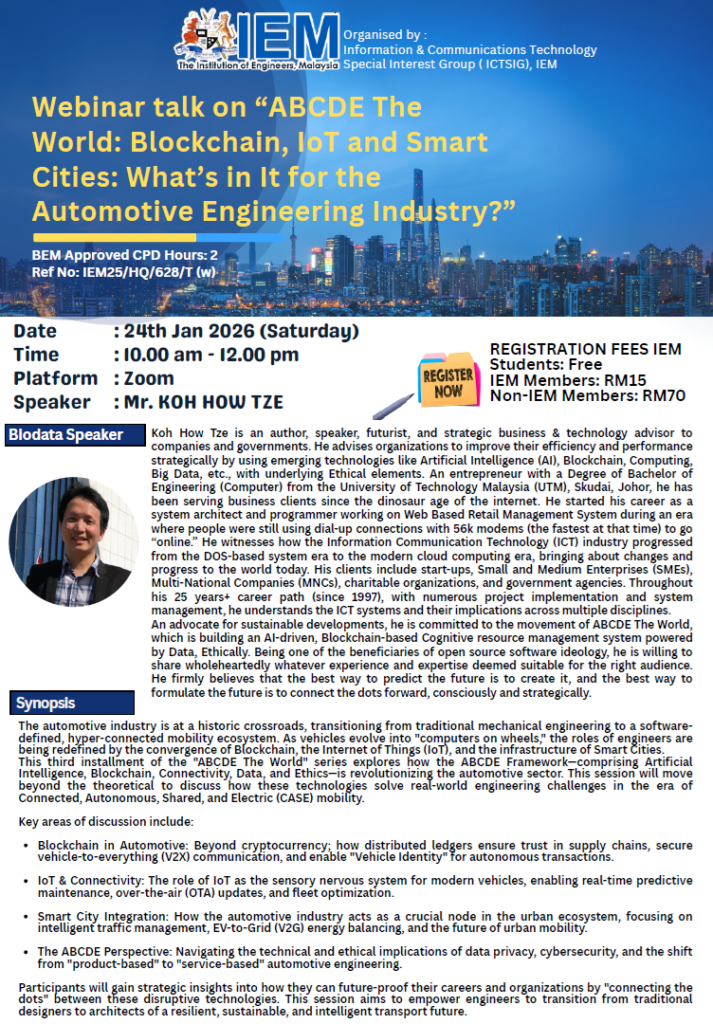
This article was inspired by the “ABCDE The World” series presented to the Institution of Engineers, Malaysia (IEM).
This article summarizes the ABCDE framework, which identifies Artificial Intelligence, Blockchain, Connectivity, Data, and Ethics as the core technologies redefining the automotive industry. It argues that vehicles are evolving from mechanical machines into “computers on wheels” that function as vital nodes within Smart Cities to improve the distribution of essential societal resources. Key advancements discussed include the transition to software-defined vehicles, the implementation of blockchain-based battery passports for sustainability, and the integration of 5G connectivity for real-time urban navigation. The text emphasizes a holistic “People, Process, Technology” strategy, urging engineers to bridge a significant skills gap by mastering both software and hardware. Ultimately, these innovations aim to create a resilient civilization where autonomous systems prioritize safety, transparency, and ethical decision-making. Future industry success depends on shifting from simple product manufacturing to providing data-driven mobility services that enhance human well-being.
As summarized by Google’s NotebookLM: