In an era defined by rapid technological acceleration, we are witnessing a fundamental shift in how civilization is engineered. We are moving away from a world of isolated hardware and towards a future of integrated intelligence. Whether we are discussing the evolution of “computers on wheels” in the automotive industry or the development of smart cities, the core challenge remains the same:
how do we build systems that optimize resource distribution to ensure a resilient future for all?
Engineering Resilient Civilizations: The ABCDE Framework for True Wealth
To answer this, we must look at the intersection of People, Process, and Technology. This foundational triad ensures that while technology provides the tools, people provide the purpose, and processes define the boundaries of our progress.
The Foundation: People, Process, Technology
Before diving into the specific technologies of the future, we must acknowledge that technology alone is not a panacea.
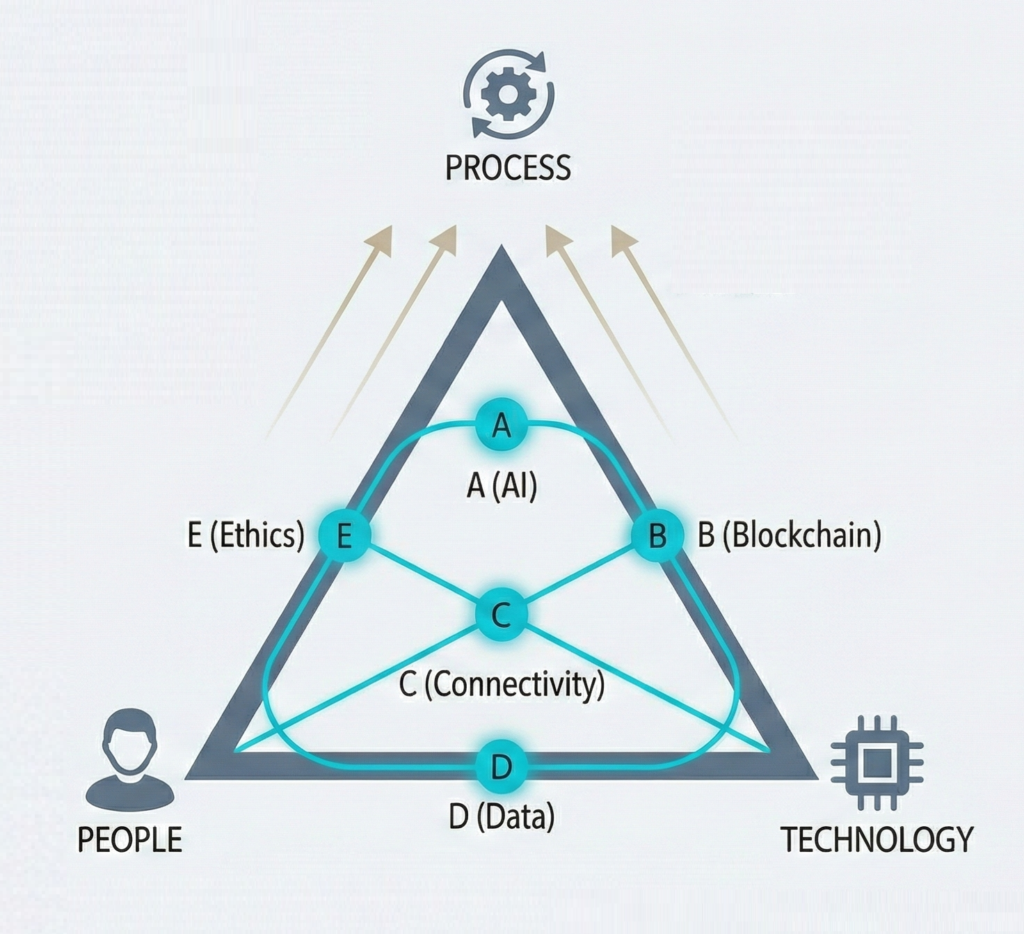
A truly resilient civilization is built on a people-centric environment that learns and grows together. As we formulate our future, visionaries provide the ideas, integrators make them reality, and engineers serve as the builders of tomorrow.
The “how” of this transformation is guided by the ABCDE Framework, a strategic roadmap consisting of five critical pillars: AI, Blockchain, Connectivity, Data, and Ethics. When applied to the 6 True Wealth Hexagon—Food, Energy, Education, Shelter, Healthcare, and Entertainment—this framework allows us to transition from “one-time transactions” to “sustainable, recurring value.”
The ABCDE Framework Explained
A – Artificial Intelligence: AI moves us from manual oversight to autonomous operation. It is the engine of optimization, enabling predictive maintenance and agentic systems that can make real-time decisions to balance complex resources.
B – Blockchain: In a fragmented world, Blockchain replaces institutional trust with cryptographic truth. It provides the “Battery Passports” for ethical sourcing and the digital identities required for a secure machine-to-machine economy.
C – Connectivity: This is the nervous system of the modern world. It binds isolated nodes—whether they are cars, homes, or sensors—into a collective intelligence, allowing information and value to flow where they are needed most.
D – Data: Often called the “new oil,” data is the raw material. Through descriptive, predictive, and prescriptive analytics, we refine this raw material into the wisdom needed to govern our cities and industries.
E – Ethics: Ethics is the compass. It ensures that inclusivity, responsibility, and morality are baked into every algorithm. From the “Trolley Problem” in autonomous driving to data privacy in healthcare, ethics keeps humanity at the center of the machine.
Transforming the 6 Pillars of True Wealth
A resilient civilization is not measured by its GDP alone, but by the strength of its True Wealth Hexagon. Here is how the ABCDE framework is currently re-engineering these six essential domains:
1. Food: Precision and Traceability
The challenge of feeding 10 billion people by 2050 requires more than just better seeds. Using the ABCDE framework, we deploy IoT sensors (Connectivity) to monitor soil health, AI (AI) to predict yields, and Blockchain (Blockchain) to ensure a transparent supply chain. This “cognitive supply chain” reduces costs and builds the agility needed to survive global disruptions.
2. Energy: The Democratization of Power
The future of energy lies in decarbonization and the elimination of energy poverty. We are shifting toward smart grids where Connectivity and Data allow for real-time forecasting of demand. Through Blockchain, we can enable Peer-to-Peer (P2P) energy trading, allowing ordinary citizens to sell excess solar power directly to their neighbors, effectively democratizing the power grid.
3. Education: Personalized and Equitable
The digital divide remains a significant barrier to resilience. By utilizing AI-powered tutors (like Khanmigo), we can provide personalized learning at scale. Connectivity ensures that world-class education reaches remote communities, while Blockchain provides immutable credentials, ensuring that a learner’s achievements are recognized globally and securely.
4. Shelter: Smart Buildings and Sustainable Cities
Modern shelter is about more than four walls; it is about sustainable, integrated developments. Projects like Merdeka 118 demonstrate how Data and AI can optimize HVAC systems and water usage. Blockchain is used to trace the origin of sustainable materials like ECOConcrete, ensuring that our “shelter” contributes to a net-zero future rather than detracting from it.
5. Healthcare: Accessibility and Privacy
With a global shortage of health workers looming, AI diagnostics and Connectivity (Telehealth) are no longer luxuries—they are necessities. Blockchain plays a critical role here in securing patient records and ensuring that consent is handled ethically, allowing for a healthcare system that is both high-tech and high-trust.
6. Entertainment: Ownership and Distribution
In the digital age, entertainment is a vital pillar of human connection. The ABCDE framework addresses the fair distribution of profits to creators through Blockchain and uses AI to personalize content delivery. However, Ethics remains paramount to ensure that streaming algorithms prioritize human well-being over addictive engagement.
Engineering the Future of Mobility
Perhaps the most visible application of this framework is in the automotive industry. We are no longer just building cars; we are building “computers on wheels.” These vehicles serve as the vectors for delivering the six pillars of the True Wealth Hexagon. In a smart city, a vehicle is not just a mode of transport; it is a mobile sensor, a data harvester, and even a decentralized energy storage unit (Vehicle-to-Grid).
Through V2X (Vehicle-to-Everything) connectivity, vehicles communicate with traffic lights to optimize speed (GLOSA) and clear paths for emergency services.
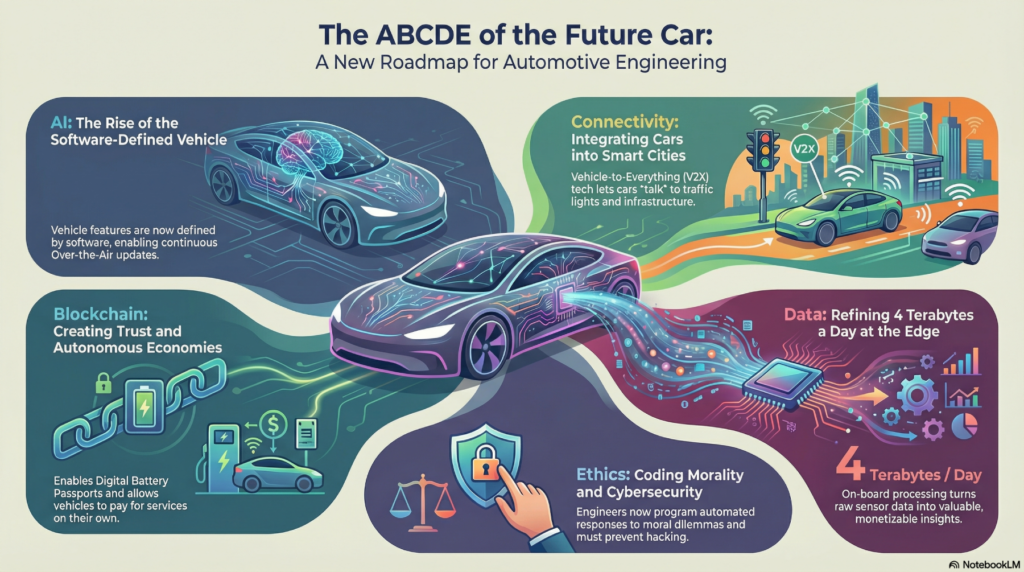
This is the “Internet of Everything” in action—a real-time nervous system that reduces waste and saves lives.
Conclusion: Leaving a Legacy
The engineering challenge of our century is not merely to build faster, stronger, or more efficient machines. It is to build a Resilient Civilization. The resources to solve our global problems have always existed; the problem has always been one of distribution.
By applying the ABCDE framework across the 6 pillars of True Wealth, we create a system that optimizes resource distribution ethically and sustainably. We move from a mindset of scarcity to one of shared prosperity. As we look toward the future, we must ask ourselves: are we merely chasing the next technological trend, or are we engineering a legacy that will sustain humanity for centuries to come?
Clarity leads to power.
By defining our goals through the lens of Sustainable Social, Environmental, and Economic Development (S.E.E.D.), we can do what we can, with what we have, where we are—towards where we want to be.
This article was inspired by the “ABCDE The World” series presented to the Institution of Engineers, Malaysia (IEM).
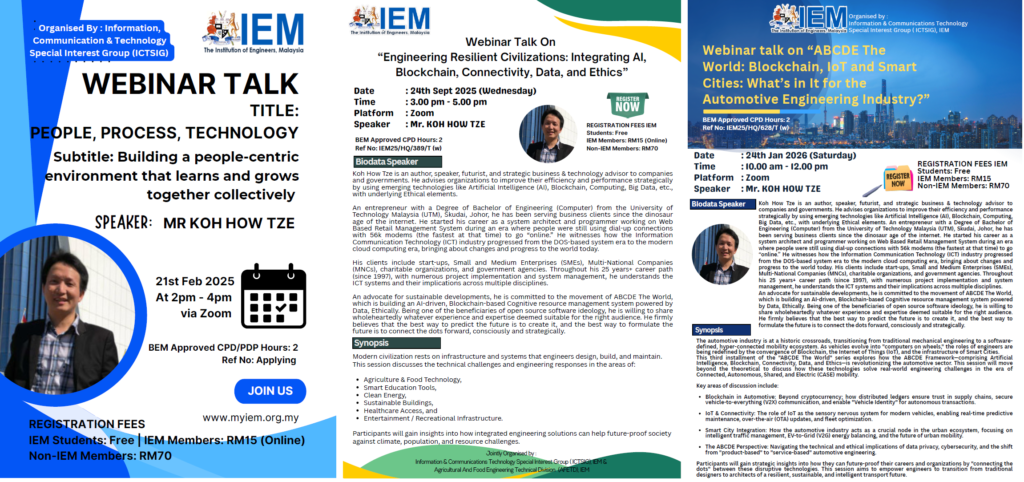
24 Jan 2026 (10:00 AM – 12:00 PM)
Webinar Talk on “ABCDE The World: Blockchain, IoT and Smart Cities: What’s in It for the Automotive Engineering Industry?”
24 Sep 2025 (3:00 PM – 5:00 PM)
Webinar Talk On “Engineering Resilient Civilizations: Integrating AI, Blockchain, Connectivity, Data, and Ethics”
21 Feb 2025 (2:00 PM – 4:00 PM)
Webinar Talk on “People, Process, Technology – Building a people-centric environment that learns and grows together collectively”