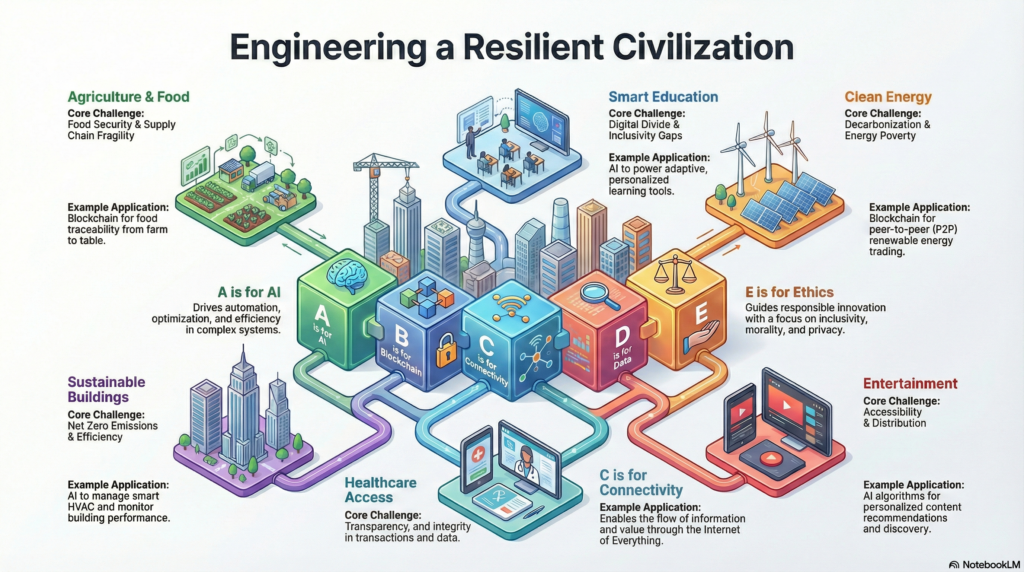
Modern civilization is built upon a complex foundation of infrastructure and systems that engineers design, manage, and maintain. However, as global society faces unprecedented pressures from climate change, population growth, and resource scarcity, the traditional methods of infrastructure development must evolve. To future-proof society, engineers are now looking toward the integration of emerging technologies through a strategic lens known as the ABCDE framework.
Understanding the ABCDE Framework
The ABCDE framework represents five pillars of technological and moral integration essential for modern resilience:
- AI & Automation: Leveraging artificial intelligence to achieve optimization and operational efficiency.
- Blockchain: Establishing trust, transparency, and data integrity within decentralized systems.
- Connectivity: Utilizing the “Internet of Everything” to ensure the seamless flow of both information and value.
- Data: Harnessing descriptive, predictive, and prescriptive insights to make informed decisions.
- Ethics: Ensuring that all technological advancements are grounded in inclusivity, responsibility, and morality.
By applying this framework across six critical domains of resilience, society can better withstand disruptions while improving overall performance.
1. Agriculture and Food Technology
The primary challenge in the agricultural sector is food security, specifically the need to feed an estimated 10 billion people by the year 2050 amidst climate instability.
Engineering responses involve the use of IoT sensors for connectivity, precision farming driven by AI, and food traceability powered by blockchain. A notable example is the IBM cognitive supply chain, which utilized data and blockchain to reduce costs by USD 160 million. During the peak of the COVID-19 pandemic, this resilient system maintained a 100% order fulfillment rate, demonstrating the power of real-time insights in managing market disruptions.
2. Smart Education
Education systems currently struggle with a significant digital divide and inclusivity gaps. Resilience in education means providing remote access to global communities while personalizing the learning experience.
The Khan Academy case study highlights how AI-powered tools like “Khanmigo” can serve as ethical AI tutors, offering on-demand support for students while reducing the administrative burden on teachers. This approach ensures that world-class education remains a free, accessible resource for anyone, anywhere.
3. Clean Energy
The energy sector faces the dual challenge of decarbonization and rising demand, coupled with the persistence of energy poverty in many regions.
To engineer a resilient grid, the industry is shifting toward smart meters and P2P (peer-to-peer) energy trading. Organizations like Powerledger use blockchain software to track, trace, and trade renewable energy. This democratization of power allows for a distributed network where individuals and corporations can harness energy generation and storage in an optimal, subsidy-free way.
4. Sustainable Buildings
Buildings must achieve net-zero emissions while enhancing the livability and walkability of their surrounding communities. Resilience here is measured by green design and performance monitoring.
The Merdeka 118 development in Kuala Lumpur serves as a benchmark for this domain. By incorporating energy-efficient systems, smart water usage, and ECOConcrete, it achieved triple platinum ratings from LEED, GBI, and GreenRE. Such projects demonstrate how commerce and culture can blend while preserving the environment for future generations.
5. Healthcare Access
The global healthcare system is strained by rising costs, inequity, and a projected shortage of 10 million health workers by 2030. Currently, approximately 4.5 billion people lack access to essential health services.
Digital transformation, including telehealth and AI-driven diagnostics, offers a path forward. The World Economic Forum’s Digital Healthcare Transformation Initiative focuses on sharing best practices and building regional innovation capacity. By using blockchain for secure health records and AI for trend monitoring, the industry can improve patient outcomes even within resource-constrained environments.
6. Entertainment and Recreation
While often overlooked in discussions of infrastructure, entertainment and recreational infrastructure are vital for societal well-being. The challenges in this domain involve accessibility and the efficient distribution of content.
Netflix serves as a prime example of resilience through technology, utilizing a blend of cloud infrastructure, microservices, and machine learning algorithms for personalization. Their use of predictive modeling for content demand and audience insights allows them to maintain a “culture of learning” that evolves with global user needs.
The Critical Role of Ethics
At the heart of the ABCDE framework is the “E”—Ethics. Engineering resilient civilizations is not merely about technological capability; it is about ensuring that these systems are inclusive and responsible. Whether it is protecting data privacy in healthcare or ensuring small farmer access in agriculture, ethical considerations prevent the “narrow-focus” that often leads to systemic failure.
Engineering Resilient Civilizations: Connecting the Dots Forward
Resilience is not a static state but a continuous process of adaptation. As noted by industry experts, the world’s problems often lie not in a lack of resources, but in the inefficiency of their distribution. By integrating AI, Blockchain, Connectivity, and Data with a firm ethical foundation, engineers can create a strategic future that is both sustainable and equitable.
The best way to predict the future is to create it, and the best way to formulate that future is to connect the technological dots forward, consciously and strategically. Through these integrated engineering solutions, society can gain the insights and agility needed to thrive against the climate and population challenges of the 21st century.
Notes
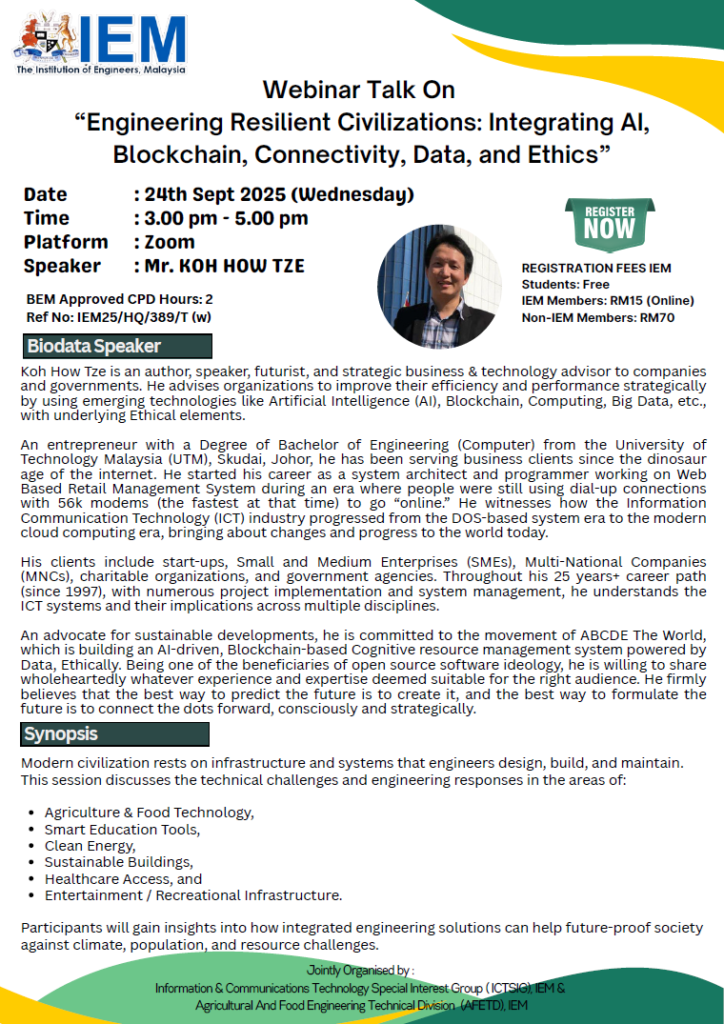
This article is the compiled info of a professional webinar hosted by The Institution of Engineers, Malaysia, focused on strengthening modern society through integrated technological frameworks.
Speaker Koh How Tze introduces the ABCDE model, which stands for Artificial Intelligence, Blockchain, Connectivity, Data, and Ethics. The presentation applies these five pillars to six critical domains, including food security, sustainable energy, and healthcare accessibility. Through various global case studies like IBM and Netflix, the sources illustrate how strategic engineering can address resource scarcity and climate instability. Ultimately, the content serves as a guide for using emerging tech to build more equitable and durable infrastructure for the future.
As summarized by Google’s NotebookLM: