In the rapidly evolving landscape of the 21st century, organizations often find themselves chasing the latest technological “silver bullet.” However, history and experience show that technology alone cannot sustain an organization or a community. To build a future that is both resilient and inclusive, we must return to a foundational triad: People, Process, and Technology (PPT).
By balancing these three pillars, organizations can move beyond mere digital adoption and toward true digital transformation—creating environments that learn, grow, and flourish collectively.
The Pillars of Modern Sustainability: Beyond the Bottom Line
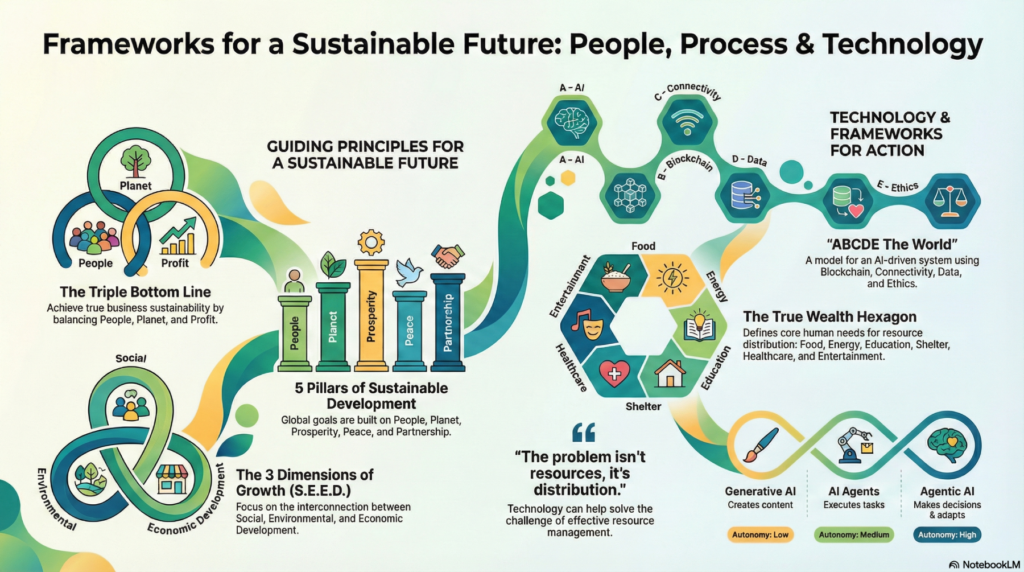
Traditional business models often prioritize profit above all else. However, as highlighted in the works of Koh How Tze, long-term viability requires a shift toward the Triple Bottom Line: People, Planet, and Profit.
Sustainability is not just a corporate social responsibility (CSR) buzzword; it is the intersection of these three elements. When we align our internal processes and technological tools with the goal of benefiting both the community and the environment, we create a legacy that lasts.
The True Wealth Hexagon
To understand what we are building for, we must define “wealth” correctly. The True Wealth Hexagon suggests that sustainable development must address six core areas:
- Food & Water: Basic survival and security.
- Energy: Clean and accessible power.
- Education: Lifelong learning and skill acquisition.
- Shelter: Safe and sustainable living environments.
- Healthcare: Physical and mental well-being.
- Economic Opportunity: The ability to contribute and thrive.
People: The Heart of the System
The “People” element is the most critical and often the most complex. A people-centric environment is one where technology serves humanity, not the other way around.
Building a Learning Culture
A sustainable organization is one that learns together. This involves fostering a “growth mindset” where employees are encouraged to experiment with new tools and processes. When people feel valued and empowered, they become the primary drivers of innovation.
The Human-Centric Design
In the PPT framework, the “People” component requires us to ask: Who are we solving this problem for? Whether it is improving efficiency for employees or accessibility for customers, the human experience must remain the North Star.
Process: The Bridge to Efficiency
Processes are the “how” of an organization. They define the boundaries, policies, and workflows that allow people to use technology effectively. Without optimized processes, even the most advanced AI or Blockchain systems will fail to deliver value.
S.E.E.D. for Development
To ensure processes are sustainable, we look at the S.E.E.D. model:
- Social: Does this process promote inclusivity and equity?
- Economic: Is it financially viable and scalable?
- Environmental: Does it minimize waste and carbon footprint?
- Development: Does it contribute to long-term progress?
By integrating these dimensions into standard operating procedures, businesses can ensure that their day-to-day operations align with global Sustainable Development Goals (SDGs).
Technology: The Catalyst for Future Possibilities
Technology should be viewed as a tool to amplify human potential. In the modern era, we are moving toward an integrated approach often referred to as the ABCDE Framework.
The ABCDE Framework
- A – Artificial Intelligence: Enhancing decision-making and automating repetitive tasks to free up human creativity.
- B – Blockchain: Providing transparency, security, and trust in resource management.
- C – Computing: The infrastructure and processing power required to run complex systems.
- D – Data: The “new oil” that, when processed ethically, provides the insights needed for strategic growth.
- E – Ethics: The underlying foundation. Technology without ethics is a liability. Ethical technology ensures that data privacy is respected and AI bias is minimized.
Strategies for Integrating PPT
How do we bring these elements together? It requires a strategic approach that connects the dots forward.
Identify SDG-Aligned Opportunities
Organizations should start by identifying which of the 17 UN Sustainable Development Goals they can impact most. Whether it is “Decent Work and Economic Growth” or “Industry, Innovation, and Infrastructure,” aligning PPT with these goals creates a clear purpose.
Apply the Social Enterprise Model
Efficiency is key: How can I do what I do for more and more people with less and less effort? This is the core of the social enterprise model. By leveraging technology to scale impact, organizations can solve social problems while remaining profitable.
The Role of Integrators and Engineers
- Visionaries provide the groundbreaking ideas.
- Integrators turn those ideas into reality by designing the processes.
- Engineers are the builders who create the technological foundations for tomorrow.
The Path Forward: Predicting the Future by Creating It
The best way to formulate the future is to begin with the end in mind. Clarity leads to power. When an organization has a clear vision of a sustainable, people-centric environment, the PPT framework becomes a roadmap rather than just a theory.
Conclusion: Leaving a Legacy through People, Process, Technology Approach
As we borrow this Earth from our children, our responsibility is to ensure that our digital transformation is sustainable. By balancing People, Process, and Technology, we move from short-term gains to long-term flourishing. We are not just building businesses; we are building a world where individuals and communities can grow together, collectively.
“Do what we can, with what we have, where we are, towards where we want to be.”
Key Takeaways for Your Organization:
- Prioritize People: Invest in training and a culture of collective growth.
- Optimize Processes: Use the S.E.E.D. model to ensure your workflows are sustainable.
- Leverage Ethical Tech: Adopt the ABCDE framework with a heavy emphasis on Ethics.
- Align with SDGs: Ensure your business model solves real-world problems.
Notes
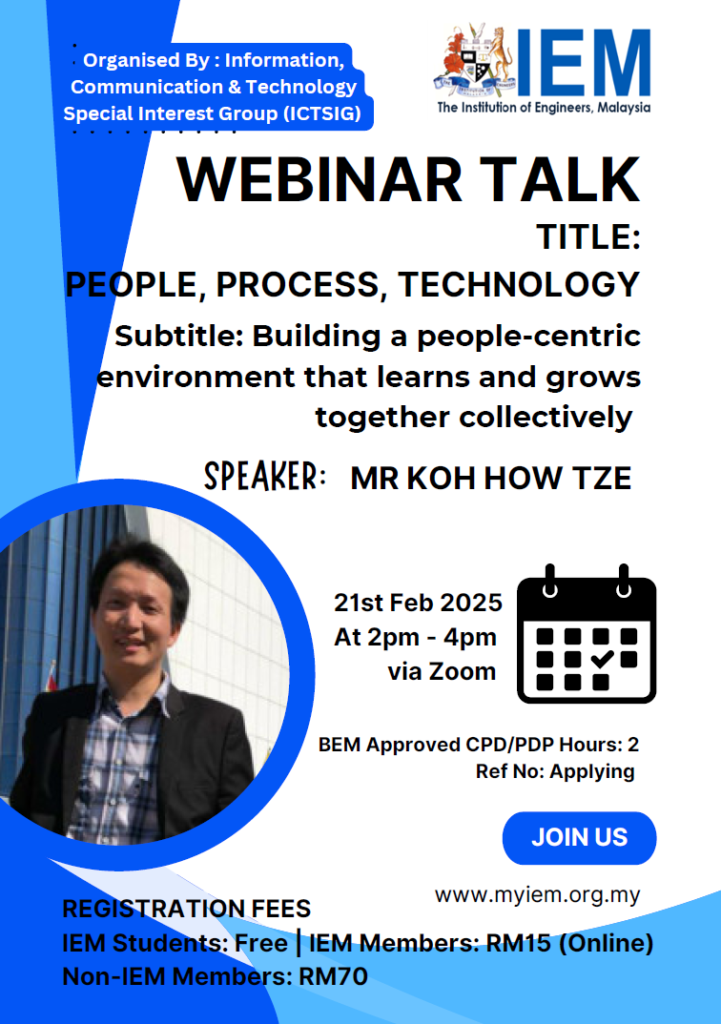
This article details the educational webinar titled “People, Process, Technology,” in February 21, 2025. Led by Koh How Tze.
The session focuses on creating inclusive environments through the integration of human values and advanced tools. Key themes include the ABCDE framework, which emphasizes the ethical application of Artificial Intelligence and Blockchain to achieve global sustainability goals. The materials highlight the Triple Bottom Line approach, advocating for a balance between social welfare, environmental health, and economic profit. By exploring concepts like the True Wealth Hexagon and S.E.E.D. development, the presentation aims to provide practical strategies for long-term growth. Ultimately, the content serves as a guide for individuals and organizations to strategically build a sustainable future using emerging technologies.
As summarized by Google’s NotebookLM: